
Part A

1.1 Meeting point!
The crisis ahead of the Earth community is one of political, socioeconomic, and ecological nature. Not just political, or socioeconomic, or ecological, but all three, deeply connected and indissociable. This statement (made in the introduction) is clear, but its fundamental reasons are still to be clarified. What does the socioeconomic crisis have to do with the environment? How do politics interact with all these other systems? Through the analysis of the historical and contemporary concepts of Nature and economic development, we will start exploring the underlying framework that connects these worlds.
1.2 Defining Politics of Nature
Ecology is defined by Oxford Dictionary as “the branch of biology that deals with the relations of organisms to one another and to their physical surroundings” and is oftentimes regarded as separate from other branches of political[10] discussions. Instead, what is called economy[11] or the flow of productive activities is, today, a central concern of politics, while the environmental impact of these economic activities remain referred to as “externalities”, raising a symbolic boundary between Nature and the realm of human influence (Raworth, 2017, p. 269). However, the same economy is the predominant exercise that extracts, transforms, and exchanges natural beings[12] globally, establishing a complex system that supports people’s life on Earth while Nature is, for most, a provider of human resources (food, materials or clean air) or enjoyment (through tourism or animal spectacles, for example). Therefore, the division between politics, Nature, and economy is not only reductive, but counterproductive to the efforts of comprehending how to work inside this network. The decisions that concern if and how humans will collectively interact with Nature (phenomena that today is predominantly economic) is certainly political, and this is how this work defines Politics of Nature.
1.3 The many names of Nature
But what is Nature? One might say Nature is what connects all beings on the Earth[13] as we all have some kind of Nature around us – trees, rocks, insects, water – wherever we are. However, it is noticeable that Nature has many names. The importance and characteristics attributed to Nature by an individual or community can be analyzed by the name it is given, in other words, by the narrative it inhabits. Natural assets, Mother Nature, environment, forest, and Natural Capital are some of the names that different groups apply to non-human natural beings that imply different attitudes in the human-nature relationship[14]. And this has, needless to say, strong political implications.
Researchers Raymond et al. (2013) discuss some of the denominations given to Nature and their practical outcomes due to semiotic implications and divide these names into what they call metaphors and approaches. While metaphors are applied to complex concepts with the aim of enabling communication between stakeholders, approaches are methods for undertaking actions (they also notice that approaches may be rooted in metaphors).
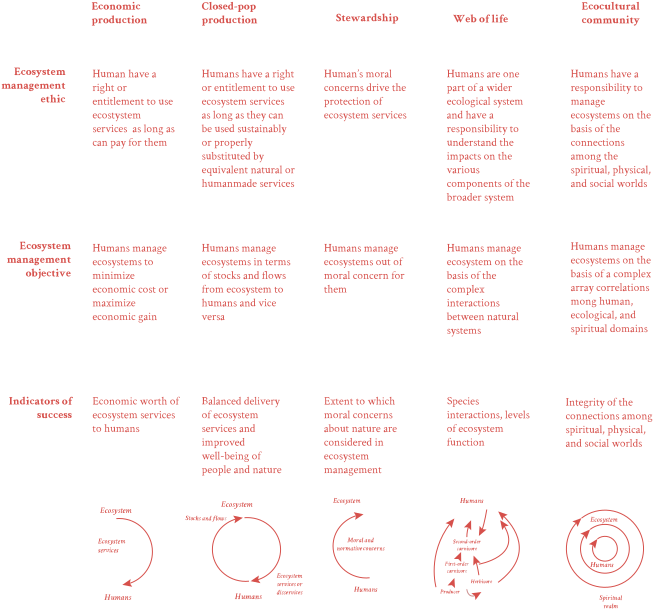
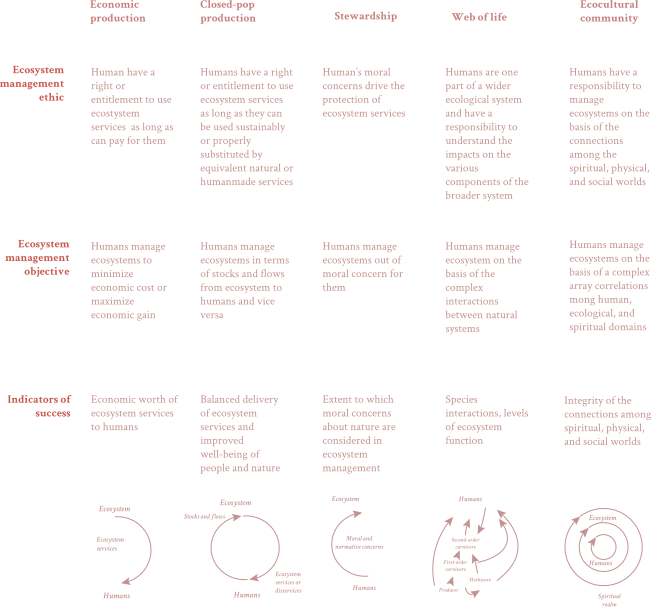
The authors study five metaphors applied in environmental politics and its strengths and weaknesses in regard to communicating, understanding, and managing human– environment interactions. They not only provide a description of the objective, ethics, and indicators of success in each metaphor but also a graphic visualization that helps understanding the character of the relationship enticed by it. This study demonstrates clearly that narratives that describe the human-nature relationship have practical political implications.
The authors acknowledge that in their studies these metaphors were crystallized in their main insights for clarity's sake and that, in their application in the real world, they are rarely seen in such pure form, often being complemented with elements of other metaphors. Nevertheless, the authors advocate for politics of Nature that are inclusive to more than one metaphor, as these represent more than practical approaches but also worldviews. They underline that unilateral views of human – environment exchange, such as the economic production metaphor – can be useful for specific cases, while completely inappropriate for others, and healthy policing should be able to manage these narratives in a comprehensive fashion.